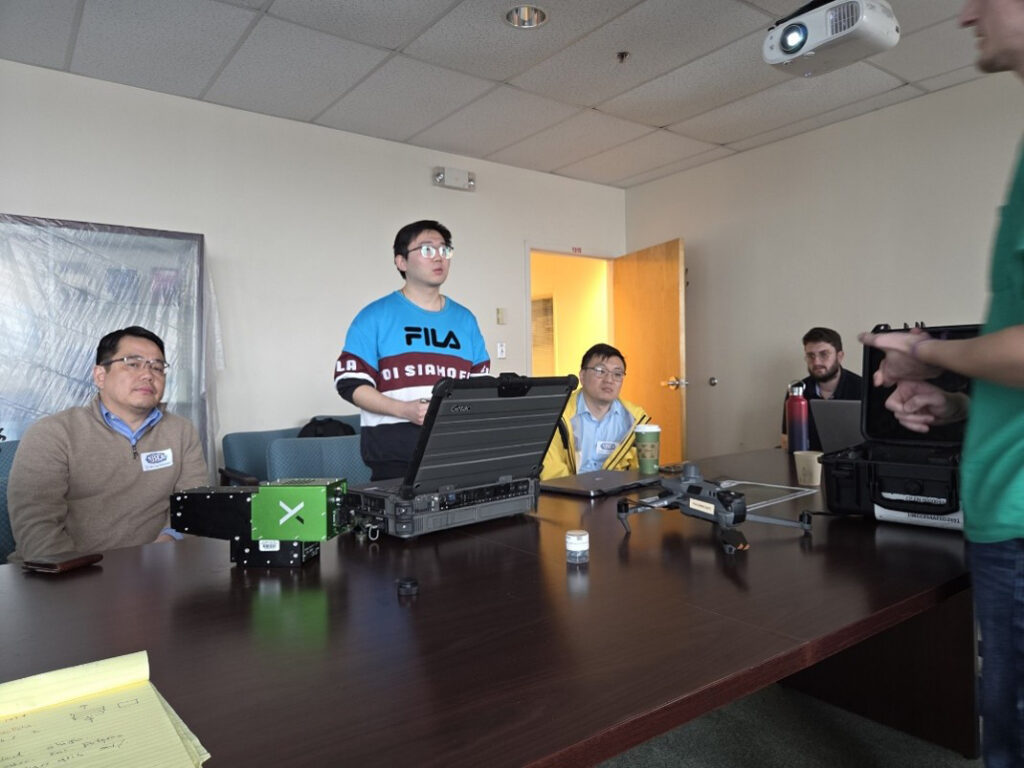
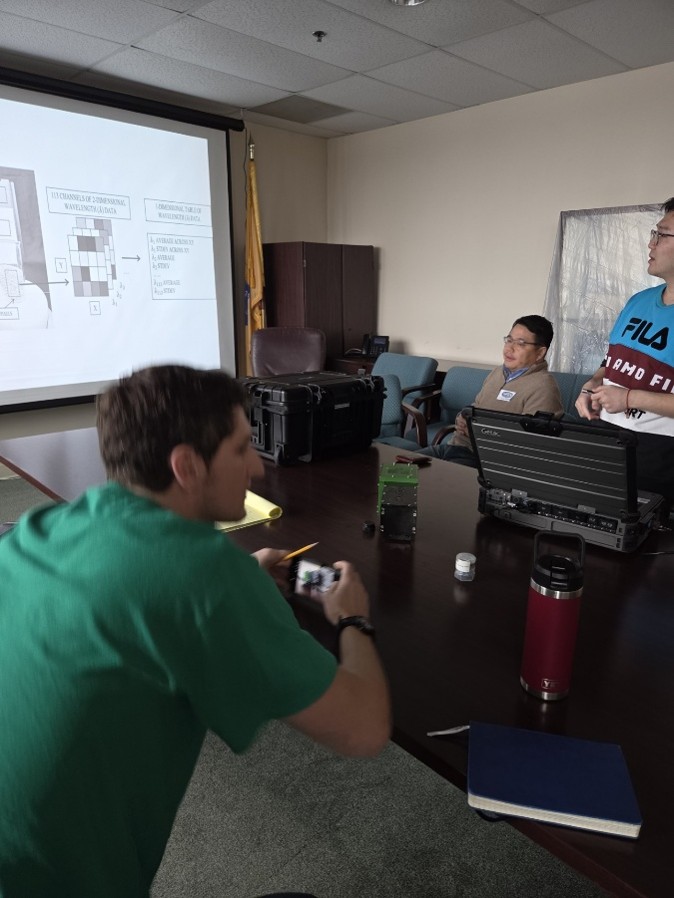
Professor Hao Wang and Dr. Ruo-Qian (Roger) Wang from Rutgers University’s Department of Civil and Environmental Engineering visited the Meadowlands Research and Restoration Institute (MRRI) on November 5 to explore opportunities to work together. Their discussions focused on using artificial intelligence (AI) to better understand long-term trends in water, sediment, and air quality in the Hackensack River Estuary.
The Rutgers researchers shared their expertise in using AI to analyze images and model water quality patterns and hydrodynamics in tidal estuaries. MRRI scientists Dr. Ying (Cheryl) Yao, Dr. Ildiko C. Pechmann, and Eric Manke presented the institute’s long-term monitoring records, historical maps and image collections, and image acquisition capabilities. Together, they explored how AI could help uncover underlying patterns in these legacy data sets.
Professor Wang and Dr. Wang also introduced their HySpex VNIR-1024N spectrometer, an instrument that measures light in visible and near-infrared wavelengths. The current model is the HySpex VNIR-1800. Their instrument scans one flight line at a time and works with a system that tracks its location and orientation, along with a computer that records the measurements. These measurements could help train an AI model to recognize algae or contaminants attached to sediment particles suspended in the estuary’s waterways.
The group also discussed a lighter HySpex camera – Mjolnir – that can be mounted on various drone platforms. This solution may further aid hyperspectral image acquisition in the estuary and collecting reference data for the AI assisted data analysis model.
Prof Hao Wang and Dr. Wang discuss drone technology with Eric Manke