Air Monitoring
Our Projects
Problem

The U.S. Environmental Protection Agency (EPA) has established National Ambient Air Quality Standards for six criteria air pollutants, i.e. ozone (O3), nitrogen dioxide (NO2), carbon monoxide (CO), sulfur dioxide (SO2), lead (Pb), and particulate matter (PM), because of their potential impacts on human health and the environment. The State of New Jersey and the federal government have established concentration standards for these pollutants to protect public health and prevent adverse environmental effects.
Objectives
To assess air quality within the Meadowlands District and support attainment of state and federal air-quality standards, the New Jersey Sports and Exposition Authority (NJSEA; formerly NJMC) has conducted long-term monitoring of major atmospheric pollutants since 2007. The program is designed to characterize ambient air-quality conditions, assess the influence of major emission sources, establish background pollutant levels, evaluate regional pollutant trends, and provide data that complement state and federal air-monitoring networks.
Activities
Since 2007, the Meadowlands Research and Restoration Institute (MRRI) at NJSEA has conducted continuous air-quality monitoring using Thermo Fisher gas analyzers (Models 410i, 48i-TLE, 42i, 49i, and 43i) to measure CO2, CO, NOx, O3, and SO2 in the New Jersey Meadowlands. This long-term monitoring program has provided valuable information on pollutant trends and the influence of major emission sources within this highly urbanized and industrialized region near Newark. Real-time air-quality data are also made available to the public through the MRRI website, complementing monitoring efforts by the New Jersey Department of Environmental Protection (NJDEP) and U.S. EPA across northern New Jersey.
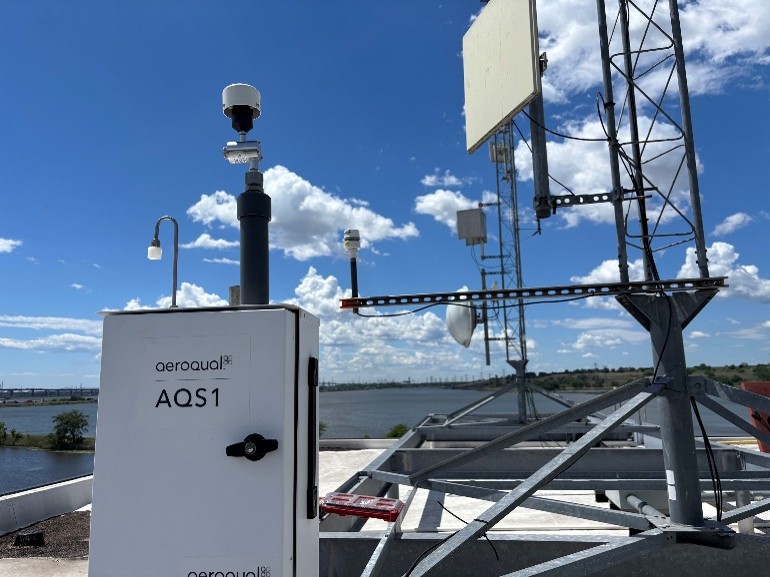
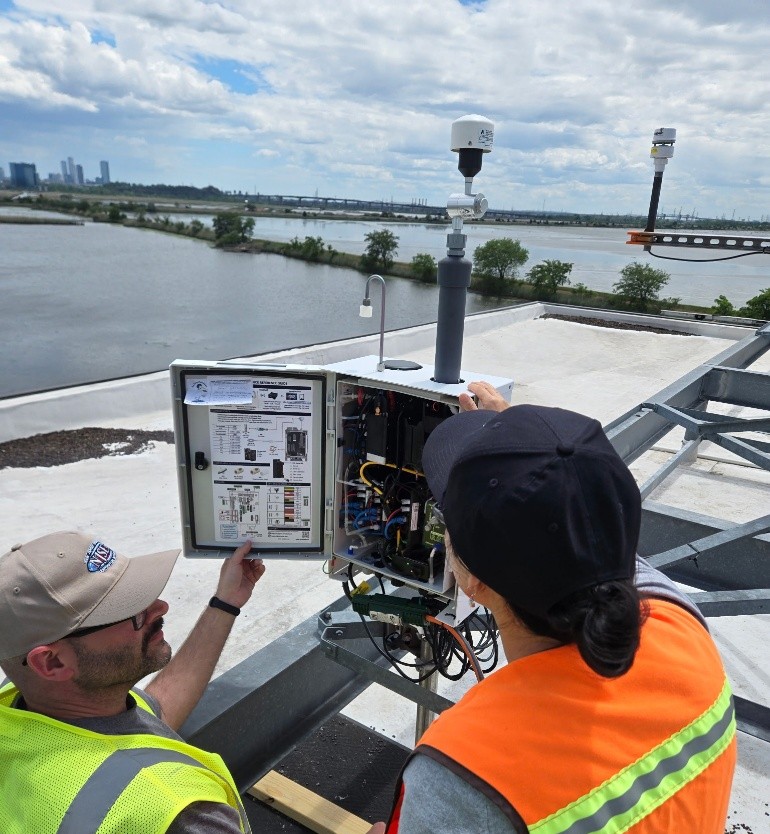
In recent years, wildfire smoke, including smoke transported from Canadian wildfires, has increased the importance of monitoring fine particulate matter (PM2.5) in the Meadowlands. At the same time, continued land development and expansion of nearby residential areas have heightened concerns regarding hydrogen sulfide (H2S) and potential community exposure. To address these emerging needs and modernize its monitoring infrastructure, MRRI upgraded its program with an Aeroqual AQS-1 integrated air-quality monitoring system, which combines laser-based PM2.5 measurement with sensors for O3, NO2, and H2S in a single compact platform. The system provides near-reference, real-time measurements, remote data access, cloud-based data management, and remote calibration capabilities. This upgrade strengthens MRRI’s ability to characterize routine and episodic air-pollution events and supports NJDEP and U.S. EPA efforts to better understand air-quality dynamics across the Meadowlands and northern New Jersey.